
If you’re a physician considering paid medical research, the first question probably isn’t “What is Sermo?”
It’s:
“How much can I actually make from one survey?”
And the answer isn’t a single number.
Medical research opportunities can range from quick, relatively low-paying questionnaires to much more substantial studies and interviews that can pay hundreds of dollars for a single participation.
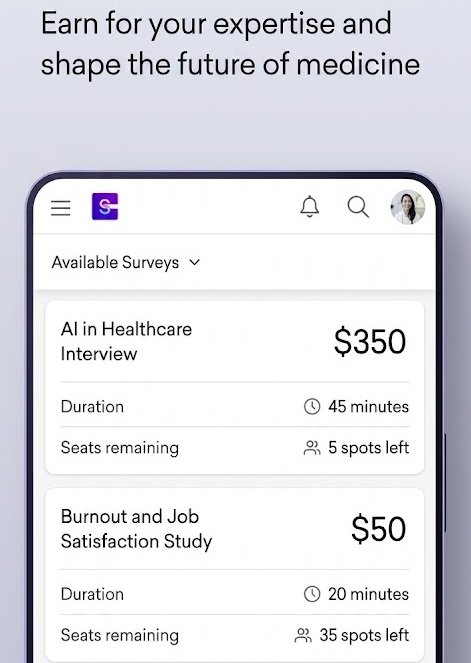
Sermo’s current physician-facing materials, for example, describe $5–$50 for short surveys and $100–$500+ for in-depth qualitative studies or interviews. Sermo also says earnings vary according to specialty, availability, and the type of survey.
So if you’ve seen claims about doctors making hundreds—or even thousands—of dollars through paid medical research, there’s an important question to ask:
What kind of study pays that much, and why?
Quick answer: A short medical survey may pay around $5–$50, while more involved research can reach $100–$500+. Sermo says highly active physicians can potentially earn $10,000+ annually, while its broader materials state that earnings vary by study. These are potential earnings, not guaranteed income.
Medical Surveys Don’t All Pay the Same
Imagine two research invitations sitting in your inbox.
Study A
10-minute online survey
Reward: $10
Study B
45-minute specialized research interview
Reward: $250
Both are technically “medical research.”
But they’re asking for very different levels of participation.
The first might require you to answer structured questions about your clinical experience.
The second could require a much deeper discussion about your specialty, treatment decisions, experience with a particular therapy, or perspective on a medical product.
That’s why looking for a single “average medical survey payment” can be misleading.
The study itself determines much of the value.
The $5–$50 Medical Survey: Quick and Simple
At the lower end are shorter studies.
Sermo currently says members can typically expect $5–$50 for short surveys lasting around 5–15 minutes.
These are the types of opportunities that can potentially fit into small pockets of downtime.
For example:
- Between appointments
- During an otherwise unused break
- After finishing a shift
- During downtime at home
But there’s an important distinction:
A $5 survey isn’t necessarily a bad opportunity.
If it takes only a few minutes, the time-to-reward ratio may still be reasonable.
Conversely, a $50 survey isn’t automatically better if it requires a substantial amount of your time.
That’s why physicians should look at both the payment and the expected time commitment.
What Can a $5 Survey Actually Mean?
Suppose a hypothetical survey pays $5 and takes 5 minutes.
That’s equivalent to an hourly rate of:
$5 ÷ 5 minutes × 60 = $60/hour
Again, that doesn’t mean you’ll actually earn $60 every hour on a survey platform.
You can’t assume you’ll continuously receive five-minute surveys.
You may also encounter screening questions, studies you don’t qualify for, or periods when there are simply no relevant opportunities.
The calculation is useful only for understanding the value of the individual opportunity.
And that’s the mindset we recommend throughout this article:
Evaluate the opportunity, not the headline.
The $50 Survey: Where the Opportunity Gets More Interesting
Once you’re looking at a survey paying around $25–$50, the economics can become more attractive.
Suppose a study pays $40 and takes 15 minutes.
That’s a hypothetical equivalent of:
$160/hour
But again, that isn’t a guaranteed hourly wage.
You aren’t employed by the research company for an eight-hour day.
You only get paid for eligible studies you actually complete.
That’s why paid medical research should be viewed as supplemental income, not as a replacement for clinical earnings.
Sermo itself describes paid medical surveys as a way to earn additional income and says surveys can be completed during downtime.
What About $100–$500+ Medical Studies?
This is where things become significantly different.
Sermo currently describes $100–$500+ opportunities as being associated with in-depth qualitative studies or interviews.
These aren’t necessarily simple check-box questionnaires.
They may involve deeper conversations or more detailed professional input.
The researcher isn’t simply trying to collect a large number of quick responses.
They’re looking for specific expertise.
And that’s what makes these opportunities potentially more valuable.
Why Would a Researcher Pay a Doctor $500?
Because the researcher isn’t really paying $500 for “answering questions.”
They’re paying for access to a very specific form of knowledge.
Consider a research company trying to understand how physicians approach a specialized treatment.
A general consumer can’t provide that insight.
Even a healthcare professional outside the relevant field may not have the necessary experience.
The researcher needs someone who has actually:
- Treated relevant patients
- Used or evaluated particular therapies
- Made clinical decisions in that area
- Encountered the associated challenges
- Worked with relevant medical technologies
- Seen the issue in real-world practice
That expertise is difficult to obtain through ordinary consumer research.
That’s why specialized medical research can command much higher compensation.
Who Gets the Higher-Paying Medical Surveys?
This is one of the most important things to understand.
You can’t simply decide:
“I want the $500 survey.”
The researcher decides what type of professional they need.
Sermo says survey invitations are tailored to members’ specialty and expertise, and that profile information such as specialty, sub-specialty, country, and career status affects eligibility.
So a high-paying study might be looking for:
- A particular specialty
- A particular subspecialty
- Physicians treating a specific condition
- Doctors with experience using a certain treatment
- Physicians in a particular country
- Professionals with a particular career status
If you don’t fit the research criteria, the payment amount doesn’t matter—you won’t necessarily qualify.
Why Your Medical Expertise Is Worth More Than a Generic Opinion
There’s a huge difference between asking:
“Which health product do you prefer?”
and asking:
“Based on your clinical experience, how would you evaluate this treatment option?”
The second question requires professional knowledge.
That’s what researchers are purchasing.
Your years of education and clinical experience have created a perspective that isn’t available from the general population.
Paid medical research simply creates a mechanism through which that expertise can be compensated.
Sermo describes its surveys as opportunities for healthcare professionals to share insights that can contribute to medical innovation, treatments, medical devices, and patient care.
How Sermo’s Payment Range Looks in Practice
Here’s a simple way to understand the range without pretending every physician will receive every type of study:
| Study type | Potential payment range | Typical idea |
|---|---|---|
| Short survey | $5–$50 | Quick online questionnaire |
| Longer/specialized research | $50–$100+ | More detailed professional input |
| In-depth qualitative study/interview | $100–$500+ | Deeper discussion or specialized expertise |
These ranges are not fixed rates. Sermo explicitly says rewards vary by study and that the amount is shown in the invitation. Its current earning page separately gives $5–$50 as a typical range for short surveys and $100–$500+ for in-depth qualitative studies or interviews.
How Much Could a Physician Make in a Month?
This is where we need to be realistic.
There isn’t a universal monthly figure.
Your earnings can depend on:
- How many studies you receive
- Whether you qualify
- Your specialty
- Your location
- Research demand
- The value of available studies
- How frequently you participate
For example, a physician who receives only a few low-paying surveys might earn relatively little.
Another physician with a highly sought-after profile could potentially qualify for more valuable research.
Sermo itself says earnings vary based on specialty, availability, and survey type.
So instead of promising:
“You’ll make $1,000 every month.”
the honest answer is:
Your monthly income can fluctuate considerably.
What About Making $10,000+ a Year?
Sermo’s current physician-facing earning page says that $10,000+ annually is possible for highly active physicians in its community.
This is different from saying that the average physician makes $10,000.
It’s an earning potential statement.
And Sermo’s support documentation emphasizes that individual survey rewards vary by study.
To put $10,000 into perspective:
$10,000 per year ÷ 12 = about $833 per month.
That doesn’t mean a physician will receive $833 every month.
Some months could be higher.
Some could be much lower.
And a physician may not have enough qualifying opportunities to reach that total.
And What About the $15,000 Figure?
You’ve probably also seen Sermo associated with an up-to-$15,000-per-year earning claim.
That number should be treated in exactly the same way:
It represents potential, not guaranteed income.
At $15,000 annually, the mathematical monthly average would be:
$15,000 ÷ 12 = $1,250 per month.
But that doesn’t mean Sermo pays physicians a monthly salary of $1,250.
The actual income comes from individual research opportunities, and those opportunities vary.
This distinction matters because a credible article should separate advertised earning potential from realistic expected earnings.
Why a $500 Study Doesn’t Mean Everyone Gets $500
This is probably the biggest misunderstanding surrounding paid medical research.
When a platform says a study can pay $500, it doesn’t mean:
Every physician who joins receives a $500 survey.
A $500 opportunity could have very specific criteria.
Researchers may need only a small number of people with a particular combination of experience and expertise.
That means:
High payment often comes with high selectivity.
You might see a $500 study but not qualify.
Another physician might qualify immediately.
That’s normal in professional research.
The Time-to-Payment Calculation Doctors Should Actually Use
Instead of obsessing over the highest payment, look at the relationship between reward and time.
Imagine:
$10 for 10 minutes
Equivalent hourly value: $60/hour
$50 for 20 minutes
Equivalent hourly value: $150/hour
$250 for 60 minutes
Equivalent hourly value: $250/hour
These are mathematical examples, not guaranteed Sermo rates.
They demonstrate why a seemingly smaller survey can still be worthwhile if it takes very little time.
And they explain why a $250–$500 qualitative interview can be attractive even when it takes considerably longer.
Don’t Forget About Screening
Another reason online discussions about survey earnings can become misleading is that not every survey invitation guarantees completion.
Research studies have eligibility requirements.
You may begin a screening process and discover that the study isn’t looking for your particular background.
That doesn’t mean the platform is necessarily misleading you.
It means the researcher was looking for a specific population.
Sermo’s own guidance tells members to keep their professional profiles updated because those details influence survey eligibility.
How to Increase Your Chances of Finding Relevant Studies
There isn’t a trick that guarantees high-paying surveys.
But you can make sure you’re visible for opportunities that actually match your background.
Keep Your Specialty Updated
Your specialty and sub-specialty can affect which studies you’re eligible for.
Enable Survey Notifications
Sermo recommends enabling email notifications for new survey opportunities.
Check the Surveys Section
Available studies can also be viewed from the Surveys section of your account.
Respond Quickly
Sermo warns that study quotas can fill, so delaying a relevant invitation can mean losing the opportunity.
Is $500 From a Medical Survey Actually Realistic?
It can be real—but it isn’t typical for every survey.
Sermo’s current materials explicitly advertise $100–$500+ for in-depth qualitative studies or interviews.
The important word is in-depth.
A 5-minute questionnaire and a detailed physician interview shouldn’t be expected to have the same compensation.
So if you’re looking for $500 opportunities, don’t think of them as ordinary surveys.
Think of them as higher-value research engagements requiring more specific expertise and participation.
What Makes Paid Medical Surveys Different From Generic Survey Sites?
A generic survey might ask you about:
- Shopping habits
- Food preferences
- Entertainment
- Consumer products
Medical research is different.
The respondent’s professional qualifications are part of the reason the study exists.
Sermo says it verifies credentials and matches surveys to healthcare professionals’ specialties and expertise.
That creates a very different value proposition.
You’re not being paid simply because you have spare time.
You’re being recruited because you have information the researcher needs.
So, How Much Do Medical Surveys Pay?
The most honest answer is:
It depends on the study.
For Sermo, its current published ranges provide a useful framework:
- $5–$50 → short surveys
- $100–$500+ → in-depth qualitative studies or interviews
- $10,000+ annually → stated potential for highly active physicians
- Up to $15,000 annually → a higher-end earning claim associated with Sermo’s physician survey opportunity
The first two describe study-level compensation ranges. The annual figures describe potential earning levels, not guaranteed income.
And that’s the distinction physicians should keep in mind when evaluating any paid research platform.
Final Verdict
Paid medical surveys aren’t all created equal.
A short questionnaire might pay only a few dollars.
A more substantial study could pay $50, $100, or considerably more.
And specialized qualitative research can reach $500+, according to Sermo’s current published earning information.
The reason for the difference is simple:
Researchers aren’t paying equally for every type of response. They’re paying for the time, depth, and scarcity of the expertise they need.
For physicians, that can make paid medical research an interesting source of supplemental income—particularly when a high-value study fits into otherwise available time.
Just don’t confuse “up to $500” with a guaranteed $500 every time you log in.
The smarter question is:
“What is this particular study paying, how long will it take, and do I actually qualify?”
That’s how to look at medical survey earnings realistically.
Frequently Asked Questions
How much do medical surveys pay doctors?
There is no universal rate. Sermo currently says short surveys typically pay $5–$50, while in-depth qualitative studies or interviews can pay $100–$500+.
Can one medical survey really pay $500?
Yes, Sermo currently advertises $100–$500+ for certain in-depth qualitative studies or interviews. However, these are not available to every physician and depend on study requirements.
Why do some medical surveys pay so much more?
Higher-paying studies generally require more specialized expertise, deeper participation, or a harder-to-recruit professional audience.
Can physicians make $10,000 a year from medical surveys?
Sermo says $10,000+ annually is possible for highly active physicians. However, actual earnings vary based on specialty, availability, study type, and eligibility.
Is $15,000 a year guaranteed on Sermo?
No. Any annual earning figure should be viewed as potential rather than guaranteed income. Individual study rewards vary, and the number of qualifying opportunities can differ between physicians.
Do higher-paying surveys take longer?
Not necessarily in every case, but Sermo specifically associates its $100–$500+ range with in-depth qualitative studies or interviews, which generally involve more substantial participation than short surveys.
Related Articles
- Real Sermo Earnings: What Doctors Can Actually Expect
- How to Monetize Your 10-Minute Clinic Delays (Without Seeing More Patients)
- The Between-Cases Side Hustle: Turning Downtime Into Extra Revenue
- How to Earn Premium Consulting Fees in the Time It Takes to Drink a Coffee
- Is Sermo Legit? An Honest Review of Payments, Surveys, and Earning Potential
Pingback: Is Sermo Legit? An Honest Review of Sermo - InsightsVaultHQ