
A physician’s schedule is rarely predictable.
You might have 20 minutes before rounds, 15 minutes between appointments, or a short break before the next case. It’s enough time for coffee—but usually not enough time to take on a conventional consulting project.
That’s where the idea of micro-consulting through paid medical research becomes interesting.
Instead of committing to meetings, clients, proposals, or another fixed schedule, you can potentially use a short window to provide something healthcare companies already value:
your professional opinion.
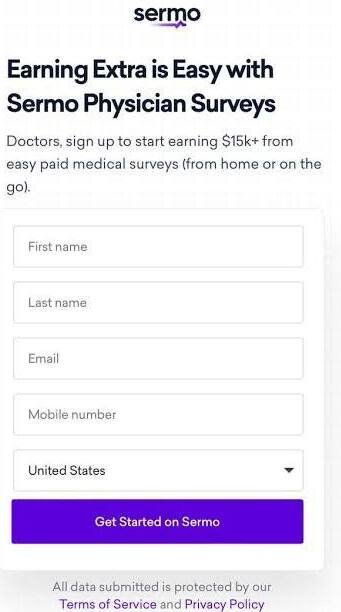
Sermo connects healthcare professionals with paid research opportunities, with survey invitations tailored to members’ specialties and expertise. Sermo says members can participate from wherever suits them, including between patients.
The idea is simple: if a 15–20 minute gap already exists in your day, why not consider an opportunity that can compensate you for the medical expertise you’re already carrying?
Your Expertise Doesn’t Stop Being Valuable When the Appointment Ends
Doctors spend years building something that companies cannot easily replicate:
clinical judgment.
You know what actually happens in practice—not just what a textbook says should happen.
You know which treatments are practical.
You know where patients struggle.
You know which technologies make your workflow easier and which ones create more problems.
And researchers want access to those real-world perspectives.
That is why paid medical research can look surprisingly different from a typical online side hustle.
You’re not learning a new skill.
You’re not building an audience.
You’re not searching for clients.
You’re providing insight based on expertise you already possess.
Why Think of It as Micro-Consulting?
Traditional consulting usually involves a defined project.
You might need to:
- Meet with a client
- Review documents
- Prepare recommendations
- Attend calls
- Complete a project
- Follow up afterward
That’s perfectly reasonable when the compensation justifies the commitment.
But it’s difficult to squeeze into a physician’s already crowded schedule.
Paid research can be much more fragmented.
A research study might ask you focused questions about your experience with a treatment, condition, medical technology, prescribing behavior, or healthcare trend.
Sermo says its survey invitations are tailored to members’ specialties and expertise.
That makes the process closer to micro-consulting: providing a concentrated piece of professional knowledge without taking on an entire consulting engagement.
What Could a Coffee Break Be Worth?
Let’s use a hypothetical example.
Suppose a particular research opportunity pays $50 and takes 15 minutes.
The equivalent hourly rate would be:
$50 ÷ 0.25 hours = $200/hour
That sounds impressive—but there’s an important qualification.
This does not mean Sermo guarantees a $200/hour consulting rate.
It’s simply a way of understanding the value of a short, paid task.
Another opportunity might take 30 minutes and pay $30.
Another could take longer and offer substantially more.
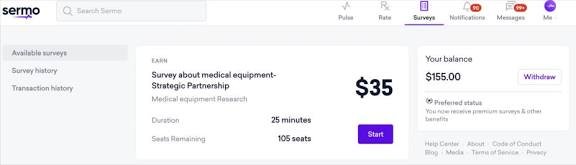
Sermo says the reward varies by study and is shown in the survey invitation.
So instead of asking:
“What is Sermo’s hourly rate?”
A physician should ask:
“What is this particular opportunity worth relative to the time it requires?”
That’s the more useful calculation.
The $5 Survey Isn’t the Whole Story
One mistake people make when looking at paid surveys is assuming every opportunity has the same value.
Sermo promotes survey opportunities ranging from $5 to $500.
A quick, straightforward questionnaire may be worth only a small amount.
A more involved study can pay substantially more.
And highly specialized research can reach the upper end of that range.
The difference comes down to what researchers need.
If a study needs thousands of broad responses, an individual respondent’s contribution may be relatively simple.
But if researchers need insights from physicians with a very specific specialty, experience, or clinical background, that expertise becomes harder to source.
That’s when the compensation can become much more interesting.
Why Pharmaceutical and Healthcare Companies Need Physicians’ Opinions
A research team can read clinical literature.
It can analyze statistics.
It can study treatment guidelines.
But there is something those sources can’t completely provide:
the physician’s real-world experience.
Consider a new healthcare product.
Researchers may want to know:
- Would physicians actually use it?
- What problems does it solve?
- What would prevent adoption?
- How does it compare with existing options?
- What matters most when choosing between treatments?
- What challenges do physicians encounter in everyday practice?
These aren’t questions that can always be answered by looking at a textbook.
They require people who actually work in healthcare.
And that’s where your professional opinion becomes the product being researched.
You Don’t Need to Become a Full-Time Consultant
This is perhaps the biggest difference.
Traditional consulting can be lucrative, but it also requires you to become a consultant.
That can involve building a reputation, networking, finding clients, negotiating rates, scheduling meetings, and managing projects.
Paid research doesn’t necessarily require that infrastructure.
You can simply participate when an appropriate opportunity is available.
Sermo’s current earning guidance recommends keeping your specialty and professional information updated because these details influence survey eligibility. It also recommends enabling survey notifications and responding quickly because research quotas can fill.
That makes the model particularly interesting for professionals who want flexibility rather than another job title.
What Does “Premium” Actually Mean Here?
Premium doesn’t necessarily mean every survey pays hundreds of dollars.
It means your professional expertise commands more value than a generic opinion.
A general consumer might be asked:
“Which healthcare product do you prefer?”
A physician could instead be asked:
“Based on your clinical experience, how would you evaluate this treatment option?”
Those are completely different types of information.
The second requires professional knowledge.
That’s why medical research platforms can compensate qualified healthcare professionals at levels that ordinary consumer survey sites generally can’t match.
Your Specialty Can Become Your Advantage
Imagine a researcher needs opinions from physicians treating a very specific patient population.
They don’t simply need “someone who works in healthcare.”
They need the right healthcare professional.
This is why keeping your professional profile accurate matters.
Sermo says specialty, sub-specialty, country, and career status can determine survey eligibility.
Your specialization can therefore work in your favor when researchers are looking for exactly the experience you have.
It doesn’t guarantee that you’ll receive more surveys.
But it explains why two physicians can have completely different opportunities on the same platform.
What About Sermo’s $15,000 Annual Claim?
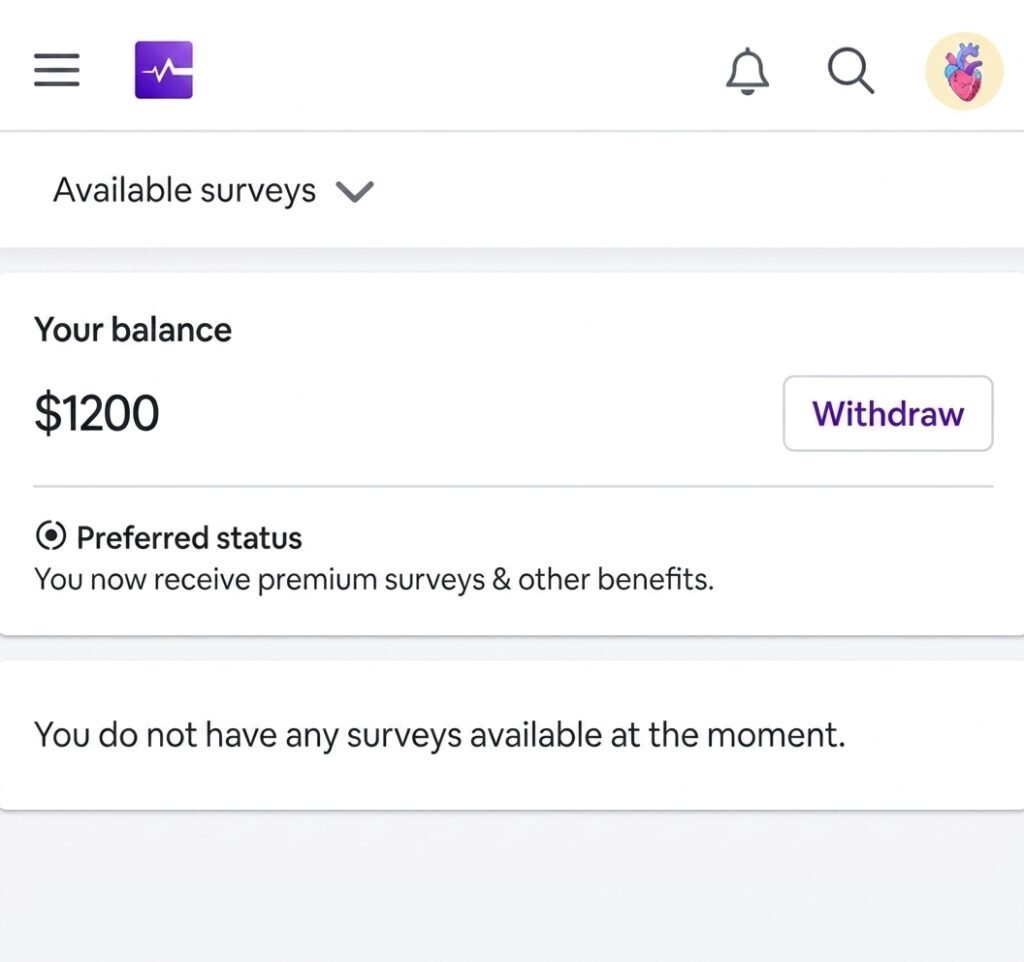
Sermo states that eligible physicians can earn up to $15,000 per year.
That figure can sound impressive—but it needs context.
It isn’t a salary.
It isn’t guaranteed.
And it doesn’t mean every physician will average $1,250 every month.
Your actual earnings can vary depending on:
- Specialty
- Location
- Survey availability
- Eligibility
- Frequency of participation
- Demand for your expertise
Think of the $15,000 figure as Sermo’s stated upper earning potential, not an expected paycheck.
The same applies to the advertised up-to-$500 survey opportunities.
A $500 research study can exist without every physician receiving one.
How to Make Short Opportunities Work Better for You
If your goal is to use small pockets of time efficiently, the process doesn’t need to be complicated.
Keep Your Profile Current
Your professional information helps determine which research opportunities are relevant to you.
Turn On Notifications
Sermo recommends enabling survey invitation emails so you know when new opportunities become available.
Look at the Reward Before Starting
If you’re genuinely short on time, check whether the opportunity makes sense for the time required.
Respond Promptly
Sermo notes that survey quotas can fill quickly, so waiting too long can mean missing an opportunity.
Don’t Treat Every Gap as Work Time
The point isn’t to monetize every coffee break.
If you need rest, take the break.
The appeal is having the choice to use some otherwise available time when you actually want to.
Could This Replace Traditional Consulting?
Probably not—and it doesn’t need to.
Traditional consulting and paid research solve different problems.
Consulting can provide larger, more substantial engagements.
Paid research can provide smaller, more flexible opportunities.
For a physician who wants to build a serious consulting practice, consulting may make more sense.
For someone who simply wants to turn occasional downtime into additional income without adding meetings and clients to their life, research participation may be much more attractive.
The Real Appeal for Busy Physicians
The biggest advantage isn’t necessarily the headline payment.
It’s the low commitment.
You aren’t promising to work every Wednesday evening.
You aren’t signing up for another shift.
You aren’t agreeing to manage a long-term project.
You are simply making your professional expertise available when a suitable research opportunity appears.
And because Sermo’s survey system is built around verified healthcare professionals and specialty-based matching, the questions can be relevant to the work you already understand.
Final Verdict
Physicians don’t necessarily need another traditional side hustle.
They may simply need a better way to use the time they already have.
A 15-minute gap isn’t enough to build a consulting business.
But it can be enough to answer a focused research questionnaire and potentially earn from expertise you’ve spent years developing.
Sermo’s opportunities range from smaller paid surveys to research opportunities advertised at up to $500, while Sermo states that eligible physicians can earn up to $15,000 per year.
Those figures represent potential—not guaranteed income.
The real attraction is the flexibility.
You don’t have to build your life around the side income. The opportunity can fit around your life.
Frequently Asked Questions
Can physicians really earn money in 15–20 minutes?
Some research opportunities may be relatively short, but survey length and compensation vary. Always check the specific invitation before deciding whether it’s worth your time.
Does Sermo pay up to $500 for surveys?
Sermo promotes research opportunities paying up to $500. However, higher-value studies depend on the specific research requirements and aren’t guaranteed for every member.
What is the highest amount Sermo says physicians can earn annually?
Sermo states that eligible physicians can earn up to $15,000 per year. This is an upper potential, not a guaranteed annual income.
Is this the same as medical consulting?
Not exactly. Paid research is generally more focused and survey/study-based, while traditional consulting can involve longer projects, meetings, and ongoing client relationships.
How does Sermo decide which surveys I receive?
Sermo says survey invitations are tailored according to factors including your specialty and expertise. Keeping your profile current can help ensure you’re considered for relevant studies.
Related Articles
- Real Sermo Earnings: What Doctors Can Actually Expect
- Best Paid Survey Sites for Physicians Compared
- Is Sermo Legit? An Honest Review of Payments, Surveys, and Earning Potential
- How to Monetize Your 10-Minute Clinic Delays (Without Seeing More Patients)
- The Between-Cases Side Hustle: Turning Downtime Into Extra Revenue
qxwqjnzhqzrfjxyxoddnokzumfzpws