
If you’re considering Sermo for paid medical research, one question probably matters more than anything else:
How much does Sermo actually pay for surveys?
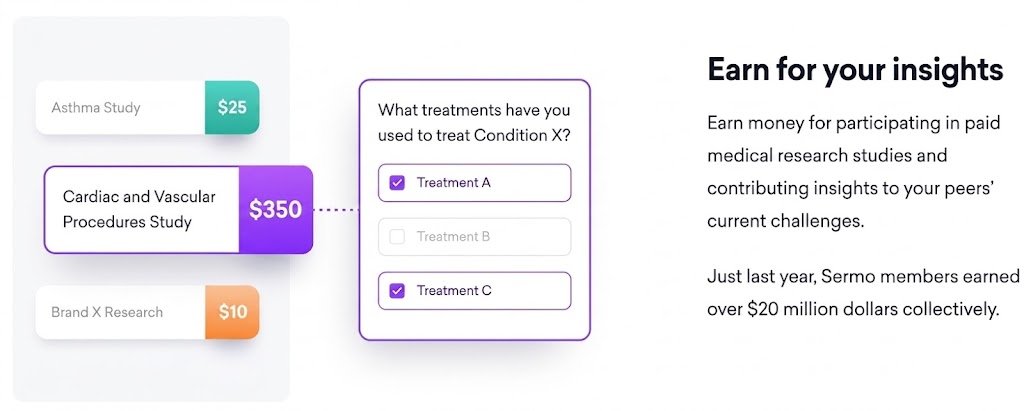
You’ve probably seen medical survey websites mention payments ranging from a few dollars to several hundred dollars. Sermo is no exception.
But there is an important detail that often gets lost in those headline numbers:
Sermo does not pay one fixed amount for every survey.
The compensation depends on the individual research study, including factors such as its length, complexity, format, specialty requirements, and the type of healthcare professional the researcher needs.
Sermo currently states that healthcare professionals can receive anywhere from $5 to $500+ for surveys, while more involved research opportunities can pay considerably more.
So what does that actually mean for a doctor or other healthcare professional?
Let’s break down how Sermo compensation works, what different types of studies can pay, and what you should realistically expect.
How Much Does Sermo Pay Per Survey?
Sermo doesn’t have a universal rate.
Its current earning information gives a broad range rather than promising one payment for every participant:
- Around $5–$50 for shorter surveys
- Around $100–$500+ for more involved qualitative research or interviews
- Potentially more for specialized or substantially more demanding research
Sermo says compensation depends on factors including the length, complexity, and specialty involved in the study.
The exact honorarium should be shown in the research invitation.
That means you shouldn’t assume that every survey you receive will pay $100 or $500.
You might receive a short study offering $10.
Another study could offer $75.
A longer interview might offer $300.
And a highly specialized research project could potentially offer even more.
The payment is determined by the study rather than by a standard Sermo hourly rate.
What Is the Typical Sermo Survey Payment?
For shorter online surveys, Sermo currently says participants can typically expect payments in the $5–$50 range.
These studies may take only a few minutes, although the actual time varies by research project.
The higher payments generally come from studies that require more than simply answering a short questionnaire.
For example, an in-depth interview may require considerably more time and professional expertise than a basic online survey.
That’s why looking only at the payment amount can be misleading.
A $25 survey that takes 10 minutes can represent a very different use of your time than a $25 study that takes an hour.
Can Sermo Really Pay $500 for a Survey?
Yes, Sermo currently advertises opportunities that can pay $500 or more, but these shouldn’t be interpreted as the standard payment for ordinary surveys.
Sermo’s earning page currently lists $100–$500+ for in-depth qualitative studies or interviews.
These higher-paying opportunities are generally more specialized.
The researcher may need professionals with a particular:
- Specialty
- Sub-specialty
- Clinical experience
- Treatment experience
- Practice setting
- Product or device experience
That makes the participant pool smaller and the professional expertise more valuable.
So if you see a $500 Sermo opportunity, it doesn’t mean every doctor can simply click a button and earn $500.
You first have to match the study’s eligibility requirements.
What Determines How Much a Sermo Survey Pays?
Several factors can affect the compensation offered by a study.
1. Survey Length
A five-minute questionnaire generally won’t require the same compensation as a one-hour interview.
The more time researchers ask you to invest, the more likely the honorarium will reflect that commitment.
However, there is no universal payment-per-minute formula.
2. Research Complexity
Some studies are straightforward questionnaires.
Others require detailed professional opinions, decision-making scenarios, interviews, or more extensive qualitative feedback.
More complex studies can command higher compensation.
3. Your Specialty
Your specialty can make a significant difference.
If researchers need a large number of general practitioners, recruiting them may be relatively straightforward.
If they need a very specific specialist with experience in a particular treatment area, the participant pool becomes much smaller.
That expertise can make certain research opportunities more valuable.
4. Professional Experience
Some studies may target healthcare professionals with particular levels of experience.
A researcher studying a specialized procedure, for example, may need professionals who perform that procedure regularly.
5. Research Format
A standard online questionnaire is different from:
- A telephone interview
- An in-depth interview
- A patient diary
- A consultation
- Other qualitative research
Sermo lists online surveys, phone/in-depth interviews, patient diaries, and other forms of paid research among its earning opportunities.
6. Demand for Your Professional Profile
Research demand changes.
A particular specialty might be heavily sought after during one period and have fewer relevant studies during another.
This is one reason two healthcare professionals can have very different Sermo earnings.
What Types of Paid Research Does Sermo Offer?
If you think Sermo only pays for ordinary online questionnaires, you’re missing part of the picture.
Sermo’s current earning documentation lists several forms of paid research.
Online Medical Surveys
These are the most straightforward opportunities.
You answer questions related to your clinical experience, professional opinions, treatments, products, healthcare systems, or other research topics.
Sermo says invitations are typically tailored to your specialty and expertise.
Phone and In-Depth Interviews
Some researchers need more detailed feedback than a questionnaire can provide.
These studies can involve speaking directly with a researcher and discussing your professional experiences or opinions.
Because they generally require more time and deeper input, they may offer higher compensation.
Patient Diaries
Some research requires participants to provide information over a period of time rather than completing one short survey.
The payment depends on the individual study.
Other Research Opportunities
Sermo also has other ways for eligible members to earn, including certain community campaigns, referral programs, and consultation-style opportunities.
However, these shouldn’t be confused with the standard paid-survey rate.
The amount and eligibility can vary considerably.
How Long Do Sermo Surveys Take?
Sermo’s current physician earning guide says paid medical surveys generally take around 5–30 minutes, although research opportunities can vary significantly in length.
A short questionnaire may take only a few minutes.
A more detailed study or interview can take substantially longer.
This is why the best way to judge an opportunity is not simply:
“How much does it pay?”
Instead, ask:
“How much does it pay relative to the time and expertise required?”
For example:
- $10 for 5 minutes = potentially reasonable
- $25 for 10 minutes = potentially attractive
- $50 for 30 minutes = depends on the study
- $300 for a one-hour specialist interview = potentially valuable
These aren’t guaranteed rates or calculations of what Sermo pays. They’re simply examples of why the time commitment matters.
Does Sermo Pay Every Time You Take a Survey?
If you complete an incentivized study according to its requirements, Sermo says the honorarium is added to your earnings balance.
However, there can be situations where the payment isn’t immediately visible.
Sermo explains that some studies are incentivized only after the entire data collection period has ended. In those cases, the payment can be added after the study closes, sometimes within about a week.
If you’ve completed a study and don’t see the expected payment, Sermo recommends checking that the survey was fully completed and contacting support with the project information if necessary.
So a payment not appearing instantly doesn’t automatically mean you weren’t paid.
How Much Can a Doctor Make From Sermo in a Month?
There isn’t a reliable fixed monthly figure.
Sermo itself says that earnings vary based on specialty, availability, and survey type. Its current earning page says highly active physicians may earn $10,000+ annually, but that should be viewed as an example of potential activity rather than a guaranteed income level.
Your monthly earnings can change depending on:
- How many invitations you receive
- How many studies you qualify for
- How quickly you respond
- How many opportunities are available in your specialty
- The payment offered by each study
- How much time you choose to spend participating
One month might be relatively active.
Another might be much quieter.
That’s normal for research panels.
If you’re specifically wondering whether doctors can reach $1,000 per month, see Can Doctors Really Make $1,000 a Month From Paid Medical Surveys? for a more realistic breakdown of what that would require.
Why Don’t Some Doctors Receive Many Sermo Surveys?
This is one of the biggest misconceptions about paid medical research.
Joining a platform doesn’t mean you’ll automatically receive a constant stream of invitations.
Sermo matches studies based on professional information, including your specialty and other profile details.
If researchers aren’t currently looking for your particular professional profile, you may receive fewer invitations.
For example, a highly specialized physician may receive an excellent opportunity when researchers need that expertise, but there may be long gaps between relevant studies.
That’s why survey availability is just as important as the advertised payment.
Do Sermo Surveys Fill Up Quickly?
Yes.
Sermo explicitly tells members that survey space can run out and recommends responding quickly to invitations.
Research studies usually have specific recruitment targets.
A researcher might need a certain number of:
- Cardiologists
- Oncologists
- Surgeons
- Primary care physicians
- Nurses
- Physician assistants
- Other healthcare professionals
Once enough eligible participants have completed the study, the quota can close.
This means you can receive an invitation, genuinely qualify, and still discover that the opportunity is no longer available.
It doesn’t necessarily indicate a problem with your account.
It’s simply how quota-based research works.
How Can You Increase Your Chances of Getting Paid Sermo Surveys?
You can’t force Sermo to send you studies.
But you can make sure you’re positioned to see relevant opportunities.
Keep Your Profile Updated
Sermo says your specialty and other professional details affect survey eligibility.
If your professional information changes, update it.
Turn On Survey Notifications
Sermo recommends enabling email notifications for new surveys so you don’t miss invitations.
This matters because some opportunities have limited quotas.
Check the Surveys Section
You don’t have to rely entirely on email.
Sermo says members can view available opportunities through the Surveys section of the platform.
Respond Promptly
If a relevant study arrives, don’t assume it will still be available tomorrow.
Quotas can fill quickly.
Don’t Misrepresent Your Experience
It might be tempting to select answers that seem more likely to qualify you for a high-paying study.
Don’t.
Researchers are paying specifically for professional expertise.
Giving inaccurate information can undermine the quality of the research and potentially create problems with your account.
Does Sermo Pay More Than Other Medical Survey Platforms?
Not necessarily.
There’s no universal platform that pays the most for every doctor.
The better comparison is based on the opportunities you actually qualify for.
A platform might advertise a $500 study, but if your specialty doesn’t match the research requirements, that payment is irrelevant to you.
Another platform might regularly offer you $50 studies that fit your expertise perfectly.
That’s why your personal experience matters more than a platform’s highest advertised number.
For a direct comparison, see Sermo vs M3 Global Research: Which Medical Survey Platform Is Better?
That comparison looks at the two platforms based on factors beyond headline payment amounts.
How Does Sermo Pay Its Members?
Once you have earnings available for withdrawal, Sermo provides payment options through the member portal.
Its current support documentation explains that you can open the withdrawal section, review the payment methods available to you, select one, enter the amount, and submit the withdrawal.
Available payment methods can vary by country.
Sermo’s current earning page mentions options such as direct deposit, PayPal, and gift cards, while its support center provides separate information for payment methods including Wise and prepaid Mastercard.
You can also view your earnings balance and transaction history in the Surveys section of your account.
Is the Money From Sermo a Salary?
No.
Sermo earnings should be viewed as supplemental income or research honoraria, not a salary.
You aren’t being employed by Sermo to work a fixed number of hours.
Instead, you’re being compensated for participating in individual research opportunities.
That means there is no guaranteed:
- Monthly salary
- Number of surveys
- Number of hours
- Minimum monthly earnings
Your income can fluctuate.
This distinction is particularly important if you’re considering Sermo as an online income source.
It’s much better to think of it as a flexible side-income opportunity than as a replacement for your primary medical income.
What About Sermo’s $5 Payments?
You may come across $5 payments associated with Sermo.
Not every $5 payment represents the full reward for a completed study.
For example, Sermo’s post-survey referral program currently says referred colleagues who are screened out of the relevant study can receive $5 in eligible circumstances.
The important thing is to look at the terms of the specific opportunity rather than assuming every Sermo survey pays $5.
Sermo’s standard research compensation varies by study.
What About the $500+ Sermo Surveys?
The opposite misconception is assuming that every survey can pay hundreds of dollars.
The $500+ opportunities are generally associated with more involved research.
Sermo’s current earning information specifically describes $100–$500+ for in-depth qualitative studies or interviews.
These opportunities can require more time and more specialized expertise.
So if you’re joining Sermo because you’ve seen “$500 per survey,” keep your expectations realistic.
You may encounter opportunities at that level.
You shouldn’t expect every invitation to pay anywhere near it.
Can You Earn $10,000 a Year on Sermo?
Sermo currently states that highly active physicians can potentially earn $10,000+ annually through its platform.
But this is an important distinction:
Potential annual earnings are not guaranteed annual earnings.
To reach that level, a physician would need enough qualifying opportunities and participation throughout the year.
Your results may be much lower.
Your specialty, location, availability, research demand, and the number of opportunities you complete all matter.
So treat $10,000+ as a potential benchmark cited by Sermo, not as an expected income target for every member.
Is Sermo Worth It for the Amount It Pays?
For the right healthcare professional, it can be.
The strongest argument for Sermo isn’t necessarily that every study pays a huge amount.
It’s the combination of:
- Flexible participation
- Healthcare-specific research
- Compensation for professional expertise
- Multiple research formats
- No fixed work schedule
- Potentially high-paying specialized studies
A five-minute survey that pays $10 won’t replace a physician’s clinical income.
But if you’re already between shifts, working from home, or have occasional downtime, paid research can turn some of that otherwise-unused time into supplemental income.
And a well-compensated specialist interview can be significantly more valuable.
The key is choosing opportunities selectively.
How Should You Judge Whether a Sermo Survey Is Worth Taking?
Before starting a study, consider three things:
Payment
How much is the honorarium?
Time
How long is the survey, interview, or research activity expected to take?
Relevance
Does the study actually match your professional expertise?
A fourth factor can also matter:
Opportunity Cost
What else could you be doing with that time?
If a survey pays $20 but takes 45 minutes and requires extensive screening, you may decide it’s not worthwhile.
If another study pays $150 for a short specialist interview, it may be much more attractive.
The highest-paying opportunity isn’t automatically the best opportunity.
The best opportunity is the one where the compensation, time commitment, and professional relevance make sense together.
Final Verdict: How Much Does Sermo Really Pay?
So, how much does Sermo pay for surveys?
The honest answer is:
It varies considerably.
Sermo currently publishes a range of roughly $5–$50 for shorter surveys and $100–$500+ for more involved qualitative studies or interviews, with compensation determined by the individual research opportunity.
Some studies will fall outside those examples.
Your specialty, experience, location, study requirements, research demand, and available opportunities all influence what you can actually earn.
Sermo also makes clear that survey opportunities aren’t unlimited. Invitations can fill quickly, and maintaining an updated profile and enabling notifications can help you avoid missing relevant opportunities.
So don’t join Sermo expecting a fixed monthly paycheck.
Instead, think of it as a way to monetize your healthcare expertise through individual research opportunities.
For a doctor or other eligible healthcare professional, that can be worthwhile—especially when the study pays well relative to the time and expertise it requires.
And that’s ultimately the number that matters more than any headline “$500 survey”:
What is your time and professional expertise worth for the particular study in front of you?