
A physician can spend an hour answering questions for a research company and walk away with more than they might make from several ordinary online surveys combined.
That is where the $200–$500+ range becomes interesting.
But there is an important distinction: Sermo does not say that every 60-minute consultation pays $200–$500. Its current paid-survey information lists short surveys at roughly $5–$50, while in-depth qualitative studies and interviews can pay $100–$500+. Sermo separately reports that physician advisory-board work can reach approximately $300–$500 per hour, depending on specialty and expertise.
So what actually makes a longer physician consultation worth hundreds of dollars?
Table of Contents
In a Hurry?
If you’re a physician looking beyond $5–$50 survey opportunities, the real opportunity is in higher-value qualitative research and expert consultation-style work.
The more specialized your expertise, the more detailed the discussion, and the harder you are to recruit, the more valuable your time can become.
And unlike taking dozens of generic consumer surveys, one well-paid research interview can potentially produce a much larger payout from a single session.
Why Would Anyone Pay $200–$500 for One Conversation?
Because a physician isn’t simply providing an opinion.
In a high-value medical research interview, the researcher may be paying for access to clinical experience that cannot easily be replaced by a generic survey respondent.
A study might need physicians who:
- Treat a particular patient population
- Use a specific class of medication
- Have experience with a medical device
- Make decisions about treatment pathways
- Have worked with a particular diagnostic technology
- Understand a specialized clinical workflow
- Can explain why physicians adopt or reject a product
- Have experience with a particular disease area
That makes the recruitment pool much smaller.
A company trying to understand how cardiologists make treatment decisions, for example, cannot simply substitute a general consumer for a practicing cardiologist.
The value is in the expertise.
What Is a High-Paying Qualitative Study?
Think of the difference between answering:
“Which treatment do you prefer?”
and spending an hour explaining why you prefer it, what influences your decision, what problems you encounter in practice, and what would make you change your approach.
The second type of research requires considerably more time and depth.
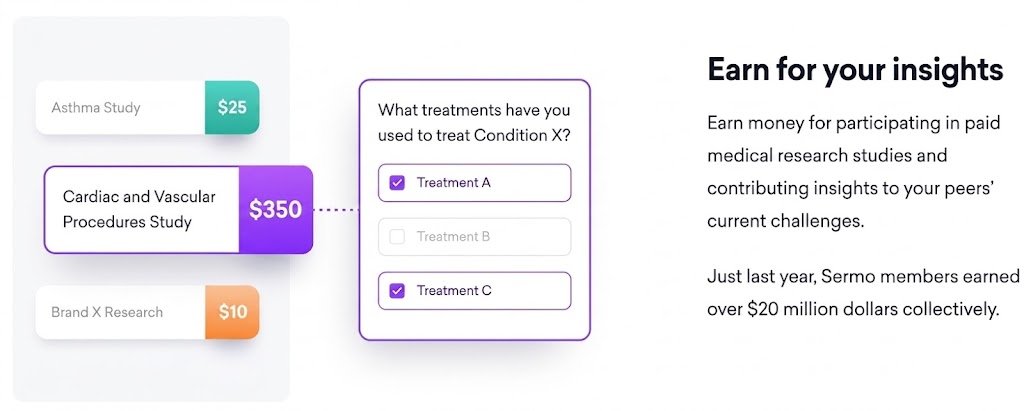
Sermo specifically lists phone interviews and in-depth qualitative studies among its paid research opportunities. Its current earning page says these deeper studies or interviews can pay $100–$500+, compared with $5–$50 for many short surveys.
That difference isn’t accidental.
The researcher isn’t just buying answers.
They’re buying access to professional judgment.
Where Does the $200–$500+ Figure Come From?
There are several different types of physician research and consulting opportunities, so it is important not to lump them together.
Short paid surveys
These are the quick opportunities.
Sermo currently says short surveys commonly pay around $5–$50 and may take approximately 5–15 minutes.
These are attractive because they require very little time.
In-depth interviews
These are much more substantial.
Sermo says in-depth qualitative studies or interviews can pay $100–$500+.
A longer interview may involve a detailed discussion about clinical practice, treatment decisions, products, technology, patient behavior, or healthcare systems.
Advisory-board consulting
This is another category entirely.
Sermo’s current physician advisory-board guidance says physicians can typically earn $1,000–$4,000 per meeting, with an approximate rate of $300–$500 per hour, depending on specialty and expertise.
These are not ordinary paid surveys. Advisory boards generally involve a small group of physicians providing strategic and clinical feedback to pharmaceutical or biotechnology companies.
That distinction matters.
A $300/hour advisory-board rate should not be presented as the guaranteed rate for a one-hour Sermo survey.
Instead, it demonstrates why specialized physician expertise can command several hundred dollars per hour in certain research and consulting settings.
So Can a 60-Minute Sermo Session Really Be Worth $300?
Potentially, yes — if the opportunity is a sufficiently high-value qualitative or consultation-style study.
Here’s the simple math.
If a hypothetical 60-minute research interview pays:
- $200 → $200/hour equivalent
- $300 → $300/hour equivalent
- $400 → $400/hour equivalent
- $500 → $500/hour equivalent
But there is an important catch.
That is the session’s mathematical hourly equivalent, not necessarily your true hourly earnings.
If you spend another 15 minutes reading the invitation, qualifying, preparing, and dealing with follow-up, a $300 session effectively becomes 75 minutes of your time.
$300 ÷ 1.25 hours = $240/hour effective rate.
Still attractive — but much more realistic.
Why Longer Interviews Pay So Much More
The biggest reason is information density.
A five-minute questionnaire can collect a handful of structured answers.
A one-hour interview can uncover:
- Why physicians make certain clinical decisions
- What frustrates them about existing products
- How treatment decisions change in real-world settings
- What barriers patients face
- How new technologies fit into clinical workflows
- What would influence adoption of a new product
- What competitors are doing differently
- Which unmet needs remain unsolved
For pharmaceutical, biotechnology, medical-device, and healthcare companies, those insights can have considerable commercial value.
The physician therefore isn’t being paid simply for sitting in front of a screen.
They’re being compensated for the expertise they bring into the conversation.
Your Specialty Can Matter More Than Your Survey Speed
One of the biggest mistakes people make with paid medical surveys is assuming that earnings are mainly about completing surveys quickly.
They’re not.
Sermo says opportunities are matched according to factors including specialty and expertise, and its support guidance specifically recommends keeping your professional profile updated because study invitations depend on those details.
That means a physician with a highly relevant specialty may qualify for a study that another physician never even sees.
For example, a study looking for a very specific oncology treatment experience may have a much smaller eligible pool than a general healthcare questionnaire.
Scarcity increases the value of access.
The $500 Study Isn’t Going to Appear Every Day
This is where realistic expectations matter.
Seeing “$500+” associated with medical research does not mean a physician can expect to log into Sermo every morning and find another $500 interview waiting.
Study availability depends on:
- Specialty
- Sub-specialty
- Current clinical experience
- Country
- Career status
- Study requirements
- Research demand
- Available participant quotas
Sermo itself says earnings vary based on specialty, availability, and survey type. It also warns that survey spaces can fill quickly.
So the better way to think about these opportunities is:
You are building access to a pool of potentially high-value studies — not signing up for a guaranteed hourly job.
How to Increase Your Chances of Getting Better-Paying Studies
You don’t control which research companies need your specialty.
But you can control whether you’re visible when they do.
1. Keep your specialty information current
Your profile helps determine which studies you’re eligible for.
If your professional information is outdated, you could miss opportunities that match your actual expertise.
2. Turn on survey notifications
Sermo recommends enabling survey invitation emails so members can respond when new opportunities become available.
3. Respond quickly
High-paying studies can have narrow recruitment criteria.
If a study requires a small number of physicians with a specific clinical background, available slots may disappear before you get around to completing the screening.
Sermo explicitly recommends responding quickly because quotas can fill.
4. Don’t exaggerate your qualifications
This one is important.
Trying to qualify for more studies by overstating your experience might get you through an initial screening, but it undermines the quality of the research and can create problems later.
The advantage of professional research panels is that your real expertise is the product.
Is a $250 One-Hour Interview Better Than Five $50 Surveys?
It depends.
Suppose you have the choice between:
Option A: Five $50 surveys
Total: $250
or:
Option B: One $250 qualitative interview
Total: $250
On paper, they’re identical.
But your time may not be.
If each $50 survey takes 15 minutes, five surveys consume about 75 minutes.
A $250 interview lasting 60 minutes consumes an hour.
That means the interview produces a higher mathematical return on your time.
But there’s another consideration: availability.
You can’t necessarily choose between five $50 surveys and a $250 interview. The higher-paying opportunity may be much less frequent.
That’s why experienced survey participants should think in terms of effective earnings over time, rather than chasing the biggest number attached to an individual study.
What Are Realistic Sermo Earnings?
This is where the marketing claims need context.
Sermo currently says short surveys can pay $5–$50, while in-depth qualitative studies and interviews can reach $100–$500+. It also says highly active physicians can potentially earn $10,000+ annually.
That does not mean every physician will make $10,000.
Your actual earnings depend on how frequently you’re invited to relevant studies, how often you qualify, the available honoraria, and how active you are.
A realistic way to view Sermo is as supplemental professional income, not a replacement for clinical income.
Even Sermo itself describes paid surveys as additional income rather than something intended to replace a physician’s full-time earnings.
For some physicians, a few small surveys may be the norm.
For others with sought-after expertise, occasional high-value interviews can make a much bigger difference.
When Is a 60-Minute Consultation Actually Worth Your Time?
Don’t look at the headline payment alone.
Look at the total time commitment.
Before accepting a $300 study, consider:
Screening time + preparation + interview + follow-up = actual time invested.
If the entire process takes 75 minutes, your effective rate is lower than the advertised $300/hour equivalent.
If there is virtually no preparation and the conversation genuinely lasts one hour, the opportunity becomes much more attractive.
Also consider your schedule.
For a physician already overloaded with patients, a $300 consultation during a protected lunch break may be far more valuable than one scheduled during an already busy clinic session.
The best paid research opportunity isn’t necessarily the one with the biggest headline.
It’s the one with the best combination of payment, time, relevance, and flexibility.
The Bigger Picture: Your Clinical Knowledge Has Market Value
There is a broader lesson behind the $200–$500+ numbers.
Physicians often think about their income almost entirely through the lens of patient care.
But pharmaceutical companies, medical-device manufacturers, research organizations, healthcare technology companies, and market researchers also need something physicians possess:
real-world clinical judgment.
That expertise can be collected through surveys, interviews, advisory boards, consulting arrangements, and other forms of professional research.
Sermo’s current advisory-board data illustrates just how valuable specialized expertise can become in higher-level consulting environments, where reported physician compensation can reach approximately $300–$500 per hour.
The important point isn’t that every physician can immediately earn $500 an hour.
It’s that an hour of specialized medical expertise can be worth substantially more than an hour of generic online survey participation.
Final Verdict
Sermo’s $200–$500+ range is real as a potential range for higher-value qualitative research and interviews, but it shouldn’t be interpreted as a guaranteed payment for every 60-minute session.
The ordinary survey ecosystem still includes much smaller opportunities, such as $5–$50 short surveys.
The bigger payouts come when researchers need something more difficult to obtain: deep professional expertise, specialized clinical experience, and a physician willing to spend meaningful time explaining it.
And that’s exactly why a single well-matched research interview can sometimes be more financially efficient than completing a pile of low-paying surveys.
Frequently Asked Questions
Does Sermo really pay $200–$500 for interviews?
Sermo currently states that in-depth qualitative studies and interviews can pay $100–$500+. The exact honorarium varies by study, so $200–$500 should be treated as a potential range rather than a guaranteed payment.
Are all Sermo surveys worth hundreds of dollars?
No. Short surveys can pay around $5–$50, while higher-value qualitative studies can pay considerably more.
Does Sermo guarantee a certain hourly rate?
No. Sermo’s survey compensation varies by study. Its reported $300–$500/hour figure relates specifically to physician advisory-board work and should not be confused with a guaranteed survey rate.
Why do some medical research studies pay more?
Higher payments generally reflect greater time requirements, specialized eligibility criteria, and the depth of professional insight researchers need.
Can a physician make $10,000 a year on Sermo?
Sermo currently says highly active physicians can potentially earn $10,000+ annually, but this is not a guaranteed income level. Actual earnings depend on study availability, specialty, eligibility, and participation.
How can I find higher-paying opportunities?
Keep your specialty and professional profile current, enable survey notifications, and respond promptly when relevant studies arrive. Sermo specifically recommends these steps because opportunities are matched to professional information and quotas can fill quickly.
Related Articles
- How to Earn Premium Consulting Fees in the Time It Takes to Drink a Coffee
- Real Sermo Earnings: What Doctors Can Actually Expect
- $25 to $500+ Per Study: How Sermo’s Medical Research Payments Work
- From $5 Quick Polls to $500 Studies: Why Medical Survey Payments Vary
- Can Doctors Really Make $1,000 a Month From Paid Medical Surveys?