
A physician can spend years building specialized medical expertise—and yet most online opportunities barely pay for it.
Paid medical research is different.
Instead of being compensated for a generic opinion, healthcare professionals are recruited because researchers need professional knowledge, clinical experience, and real-world insight.
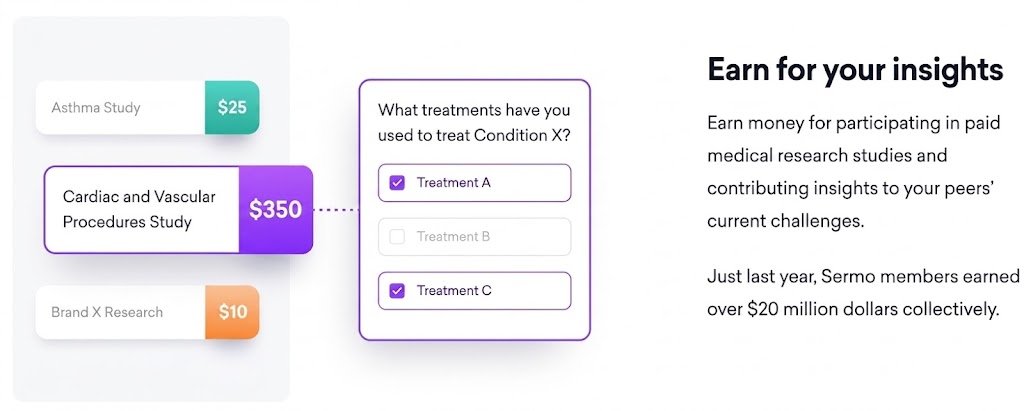
That is why one medical research study might pay $25, while another can offer $500 or more.
Sermo’s current physician-facing information says healthcare professionals can earn $5–$50 for short surveys, while in-depth qualitative studies and interviews can pay $100–$500+. Sermo also says earnings depend on factors including specialty, availability, and survey type.
But what actually determines where a study falls within that range?
And does seeing “$500+” mean a physician can realistically expect to receive that amount regularly?
Let’s break down how the payment model works.
In a hurry? Think of Sermo’s earning range in tiers: shorter surveys can fall around $5–$50, while deeper research interviews and qualitative studies can reach $100–$500+. The higher amounts are tied to specific studies and expertise requirements—not guaranteed payments for every survey.
Why Doesn’t Every Medical Survey Pay the Same?
The simplest explanation is:
Not every research project requires the same thing from the physician.
Imagine a researcher needs a quick answer from 500 healthcare professionals.
The study might ask a few focused questions and take 5–10 minutes.
Now imagine another researcher needs to speak with 20 oncologists who have experience with a specific treatment.
The second project has a completely different recruitment challenge.
The researcher isn’t simply buying 20 minutes of someone’s time.
They’re trying to access a very specific professional population.
That scarcity can affect the compensation.
Sermo itself says survey opportunities are tailored to a member’s specialty and expertise.
The $5–$50 Tier: Short Medical Surveys
At the lower end of Sermo’s published range are shorter surveys.
Sermo currently says members can typically expect $5–$50 for short surveys lasting around 5–15 minutes.
These studies are designed to gather relatively focused information without requiring a lengthy commitment.
For a physician, the attraction is flexibility.
A short survey might fit into:
- A genuine gap between appointments
- An evening at home
- A break during a shift
- Other unused personal time
But there’s an important point here:
$5 isn’t necessarily “low” if the survey takes only a few minutes.
Consider a hypothetical $10 survey that takes 10 minutes.
Its mathematical hourly equivalent is:
$10 ÷ 10 minutes × 60 = $60/hour
That doesn’t mean Sermo pays physicians $60 per hour.
There is no guaranteed flow of surveys, and you aren’t being paid for every hour you remain available.
It simply shows why time-to-reward matters more than looking at the payment amount alone.
The Middle Ground: When Medical Research Becomes More Specialized
Between a quick questionnaire and a lengthy expert interview are studies that require more detailed professional input.
The exact compensation isn’t necessarily predictable.
A study might ask physicians to evaluate:
- A treatment approach
- A medical device
- A clinical scenario
- A pharmaceutical product
- A healthcare technology
- Treatment preferences
- Challenges in clinical practice
The more specific the research question, the more important it becomes to recruit people with the right professional background.
This is why two physicians on the same platform can receive completely different opportunities.
One might see a short general survey.
Another might be invited to a study specifically targeting their specialty.
The $100–$500+ Tier: In-Depth Research
This is where the numbers become substantially more interesting.
Sermo currently lists $100–$500+ for in-depth qualitative studies or interviews.
The phrase “in-depth” matters.
These aren’t necessarily ordinary five-minute questionnaires.
A qualitative study or interview can require physicians to explain their reasoning, experiences, preferences, and observations in much greater detail.
The researcher is looking for depth rather than volume.
That is one reason compensation can rise significantly.
Why Would a Company Pay $500 for One Physician’s Opinion?
Because the right physician can be difficult to replace.
Suppose a healthcare company is researching a specialized treatment.
It doesn’t necessarily need 10,000 random people.
It might need a much smaller group of physicians who have:
- Experience treating the relevant condition
- Familiarity with the treatment category
- A particular specialty
- A certain patient population
- Experience making relevant clinical decisions
Finding those professionals is itself part of the research challenge.
So the compensation isn’t simply:
“Here is $500 for answering some questions.”
It’s closer to:
“We need access to your specific professional expertise for this research project.”
That’s a fundamentally different value proposition from generic consumer surveys.
Does Every Physician Have Access to $500 Studies?
No.
And this is one of the most important distinctions to make.
Sermo says that survey invitations are tailored to members’ specialty and expertise, while its earning information says actual earnings vary according to specialty, availability, and survey type.
So a $500 study can exist without being available to everyone.
For example, a researcher might need a narrow group of physicians with experience in a particular clinical area.
If your profile doesn’t match the criteria, you may never see that particular study.
That’s not unusual.
Professional research is often highly targeted.
The Specialty Factor
Your specialty can influence the types of studies you’re eligible for.
Sermo specifically lists physician research opportunities across specialties including:
- Oncology
- Cardiology
- Neurology
- Dermatology
- Endocrinology
- Gastroenterology
- Pulmonology
- Rheumatology
- Nephrology
- Urology
- Infectious disease
and others.
This doesn’t mean that one specialty automatically receives higher payments than another.
Instead, it means different research projects need different expertise.
A highly specialized study can therefore be available only to a relatively small pool of physicians.
The $500 Number Shouldn’t Be Treated Like a Salary
Seeing “$500+” can easily create the wrong expectation.
A physician might think:
“$500 per survey × several surveys a week = huge income.”
But that’s not how medical research works.
A $500 study may:
- Have strict eligibility criteria
- Be available only to a limited number of professionals
- Require substantially more time
- Focus on a narrow specialty
- Close once its recruitment quota is reached
Sermo itself warns that study spaces can run out and recommends responding promptly to relevant invitations.
So the correct interpretation is:
$500+ is the potential compensation for certain research opportunities—not a standard payment per survey.
What Does Sermo Say About Annual Earnings?
Sermo’s current earning page says highly active physicians in its community can earn $10,000+ annually.
That is an important figure—but it needs context.
It doesn’t mean every physician should expect $10,000.
It also isn’t a fixed salary.
The amount depends on how many suitable studies you receive, how often you qualify, and the compensation attached to those studies.
For perspective:
$10,000 per year ≈ $833 per month
But real survey earnings don’t necessarily arrive evenly.
One month could be much stronger than another.
And What About the $15,000 Figure?
Sermo has also used up to $15,000 per year in its promotional earning materials.
That would mathematically average:
$1,250 per month
if spread evenly across 12 months.
But again, this shouldn’t be interpreted as a monthly payment.
It is an upper earning potential, not a guarantee that a physician will receive $1,250 every month.
This distinction is particularly important when comparing paid research with employment.
A salary is predictable compensation for defined work.
Survey income depends on available research + eligibility + participation.
How Much Is $500 an Hour Really Worth?
Let’s say a hypothetical study offers:
$500 for a 60-minute interview.
The mathematical equivalent is obviously:
$500/hour
But if the same study requires two hours of preparation and a one-hour interview, the effective rate becomes:
$500 ÷ 3 hours = about $167/hour
This is why the headline payment isn’t the whole story.
Before accepting a study, physicians should consider:
- The honorarium
- Estimated completion time
- Any preparation required
- Whether the subject is relevant to their expertise
- Whether the opportunity fits their schedule
That gives you a much more realistic picture of the value.
What Happens After You Complete a Sermo Study?
Sermo says that after completing a survey, the honorarium is added to your balance. You can view your balance through the Surveys section of your account.
However, some studies are incentivized only after the complete data collection process finishes.
Sermo says this usually occurs within about a week after a study closes.
So completing a study doesn’t necessarily mean the payment will appear instantly in every situation.
That’s another reason to distinguish survey completion from payment processing.
How Do You Actually Withdraw the Money?
Sermo provides a withdrawal process through the Surveys section.
According to its current support documentation, members can select Withdraw, review available payment methods, choose their preferred method, enter the amount, and confirm the transaction.
Sermo’s current earning page also lists options including direct deposit, PayPal, and gift cards, although available methods can vary.
For PayPal specifically, Sermo says it uses Hyperwallet and requires the PayPal email address to match the email associated with the Sermo member account.
So the earning process isn’t simply:
Survey → instant cash
It’s more accurately:
Invitation → qualification → study completion → honorarium credited → withdrawal
What If You Don’t See Your Payment?
Sermo has a specific support article for this situation.
It says that if you’ve completed a survey but don’t see the earnings, you should reopen the survey link and confirm that the entire survey was completed.
If you’ve completed it fully and the payment still isn’t visible, Sermo advises contacting support with the project name and project code from the invitation email.
That makes keeping your survey invitation information useful if you ever need to resolve a payment issue.
How Can Physicians Maximize Their Chances of Finding Better Studies?
There isn’t a secret button that unlocks $500 surveys.
But there are practical things you can do.
Keep Your Specialty Information Accurate
Sermo says study invitations depend partly on the specialties listed in your profile.
Enable Survey Notifications
Sermo recommends enabling emails for new survey opportunities.
Check the Surveys Page
Available opportunities can be viewed directly from the Surveys section of your account.
Respond Promptly
Research quotas can fill, so a relevant invitation may not remain available indefinitely.
Don’t Chase the Highest Number
A $40 survey that takes 10 minutes can potentially be more attractive than a $100 study requiring several hours.
Your goal should be value—not simply the biggest number.
Is $25 a Bad Medical Survey Payment?
Not necessarily.
Suppose a survey pays $25 and takes 10 minutes.
That’s a mathematical equivalent of:
$150/hour
Again, that’s not a guaranteed hourly income.
But it illustrates why the payment-per-minute relationship is more important than the raw dollar figure.
A physician with only 10 minutes of free time might prefer a $25 short study over a $100 study that requires an hour and extensive preparation.
Is a $500 Medical Research Study Worth It?
It depends.
A $500 opportunity is obviously attractive on paper.
But consider what you’re being asked to do.
If it requires:
- Extensive preparation
- A lengthy interview
- Multiple sessions
- Follow-up questions
- Detailed documentation
then the actual time commitment may be considerably larger than the headline suggests.
On the other hand, if you’re exactly the professional the researcher needs and the study fits naturally into your schedule, it could represent a valuable use of your time.
The best-paid opportunity isn’t necessarily the one with the highest headline payment.
It’s the one with the best combination of:
payment + relevance + time + flexibility.
What Makes Sermo Different From Generic Survey Sites?
The fundamental difference is the respondent.
Generic survey websites usually want consumers.
Sermo is specifically built around healthcare professionals and says it connects qualified members with studies tailored to their clinical expertise.
That changes the economics.
A company conducting medical research may need the opinion of someone who has spent years treating patients in a specific area.
That’s not an opinion that can simply be purchased from the general public.
It’s specialized professional knowledge.
The Bottom Line on $25 to $500+ Medical Research
Sermo’s current published information gives physicians a useful framework:
Short surveys: approximately $5–$50
In-depth qualitative studies/interviews: $100–$500+
Highly active physicians: Sermo says $10,000+ annually is possible.
But none of those numbers should be interpreted as guaranteed income.
The $500+ opportunities exist because certain research projects require deeper participation and more specialized expertise.
And the annual earning potential depends on how many relevant studies you qualify for and complete.
So if you’re considering paid medical research, don’t ask only:
“How much does Sermo pay?”
Ask:
“What type of study is this, how much does it pay, how long will it take, and why was I selected?”
That question will tell you far more about the actual value of the opportunity.
Frequently Asked Questions
What is the lowest amount Sermo pays for a survey?
Sermo currently says short surveys can pay around $5–$50, depending on the study.
Can a Sermo survey pay $500?
Yes. Sermo currently lists $100–$500+ for certain in-depth qualitative studies or interviews.
Why do some Sermo studies pay much more?
Higher-paying research generally requires deeper participation or access to specific professional expertise. The exact payment depends on the individual study.
Does every physician get $500 surveys?
No. Sermo says invitations are tailored to specialty and expertise, so eligibility varies by study.
Can Sermo provide $10,000 a year?
Sermo says highly active physicians in its community can earn $10,000+ annually, but this is potential income rather than a guaranteed amount.
How do Sermo members receive their money?
Sermo provides several withdrawal methods, with options including direct deposit, PayPal, and gift cards depending on availability.
Related Articles
- How Much Do Medical Surveys Pay? A Doctor’s Guide to $5–$500+ Studies
- The Between-Cases Side Hustle: Turning Downtime Into Extra Revenue
- How to Earn Premium Consulting Fees in the Time It Takes to Drink a Coffee
- How to Monetize Your 10-Minute Clinic Delays (Without Seeing More Patients)
- Real Sermo Earnings: What Doctors Can Actually Expect